Kitchen note
World's top 10 most unique buildings
Architecture is often about creativity, innovation, and pushing the boundaries of traditional design. Around the world, some buildings stand out not because they blend into their surroundings, but because they challenge expectations with strange shapes, unexpected concepts, and imaginative ideas. Let’s explore some of the most unusual architectural wonders around the globe.
Stella Crawford
Cook
Bench note
The full story and useful tips are below.
Shelf
Plant kitchen
Architecture is often about creativity, innovation, and pushing the boundaries of traditional design. Around the world, some buildings stand out not because they blend into their surroundings, but because they challenge expectations with strange shapes, unexpected concepts, and imaginative ideas. Let’s explore some of the most unusual architectural wonders around the globe.
Nativity of the Giraffe – Paris, France
Designed by Hondelatte Laporte Architectes and completed in 2012, the Nativity of the Giraffe is a childcare facility in Paris that turns architecture into a playful experience. The building features several large animal sculptures, including an enormous giraffe that seems to pass directly through the structure.
The architects created these eye-catching elements to encourage children’s imagination and creativity, transforming the building into a fun and inspiring environment rather than just a typical daycare centre.
The Dubai Frame – Dubai, United Arab Emirates
Standing 150 metres high and 105 metres wide, the Dubai Frame is considered the largest picture frame in the world. Designed by architect Fernando Donis, the structure was created with the idea of “framing” Dubai’s existing landmarks instead of adding another traditional monument.
The concept represents the connection between the city’s past, present, and future. However, the project has also attracted controversy, as Donis claimed that although his design won an international competition organized by the Dubai government, the final construction proceeded without a formal contract or payment agreement with him.
Atomium – Brussels, Belgium
Originally built for the 1958 Brussels World Fair, the Atomium is one of Belgium’s most recognizable landmarks. Designed by engineer André Waterkeyn together with architects André and Jean Polak, the structure represents an enlarged model of an iron crystal molecule.
The futuristic building consists of nine connected stainless-steel spheres, with six open to visitors. Created as a symbol of the Atomic Age, the Atomium was originally intended to stand for only six months but has since become a permanent museum attraction. It was also once home to one of the fastest elevators in the world, reaching speeds of 5 metres per second.
Ilinden – Kruševo, North Macedonia
Located in Kruševo, the Ilinden Monument was designed by artists Jordan Grabuloski and Iskra Grabuloska and completed in 1974. The unusual white structure honors the fighters and revolutionaries involved in the Ilinden Uprising of 1903, as well as the Macedonian national liberation movement during World War II.
Inside the monument’s dome are important historical memorials, including the tomb of Nikola Karev, the president of the Kruševo Republic, along with a bust dedicated to famous Macedonian singer Toše Proeski.
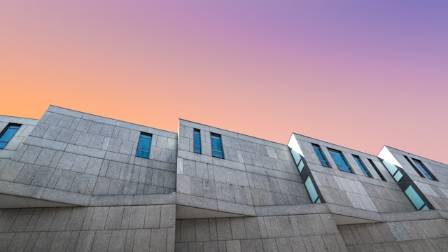
National Fisheries Development Board Building – Hyderabad, India
This remarkable fish-shaped building is located near Hyderabad and serves as the regional headquarters of the National Fisheries Development Board. Completed in 2012, the structure’s design reflects its connection to the fishing industry.
The unusual appearance was inspired by Frank Gehry’s famous fish sculpture in Barcelona, creating a building that is both functional and instantly recognizable.
Wuxi Wanda Cultural Tourism City Exhibition Center – Wuxi, China
This enormous rotating teapot-shaped building in Wuxi, China, is an exhibition centre inspired by traditional local culture. Its unusual appearance makes it one of the city’s most eye-catching landmarks.
Beyond its role as an exhibition space, the rotating structure was designed to provide entertainment functions as well, including features inspired by attractions such as roller coasters, Ferris wheels, and water parks.
Cube Houses – Rotterdam, Netherlands
Designed by Dutch architect Piet Blom, the Cube Houses in Rotterdam are a unique collection of tilted residential buildings based on the idea of “living as an urban roof.”
Each cube-shaped home is rotated 45 degrees and placed on top of hexagonal pillars, creating a striking visual effect. The design was intended to make better use of limited urban space while providing a creative arrangement of interior rooms.
Dancing House – Prague, Czech Republic
The Dancing House in Prague was designed by Vlado Milunić in collaboration with Frank Gehry and completed in 1996. The building serves as the headquarters of Nationale-Nederlanden, a Dutch insurance company.
Its unusual curved shape and deconstructivist style, sometimes described as “New Baroque,” caused debate when it was first introduced because it contrasted sharply with Prague’s traditional Baroque, Gothic, and Art Nouveau architecture. Today, it has become one of the city’s most famous modern landmarks.
Sharp Centre for Design – Canada
The Sharp Centre for Design is part of the Ontario College of Art and Design in Toronto. Created by Alsop Architects in partnership with Robbie/Young + Wright, the building features a large rectangular structure suspended 26 metres above the ground.
The unusual upper section is supported by twelve steel columns and appears to float above the older campus buildings below. The elevated design connects to existing structures through a central lift and staircase system, creating a dramatic combination of old and new architecture.
Selfridges Building – Birmingham, England
The Selfridges Building is one of Birmingham’s most recognizable modern landmarks. Designed by the architecture firm Future Systems and completed in 2003, the building features a steel framework covered with a sprayed concrete exterior.
Its futuristic curved surface has become an architectural symbol of the city and played an important role in Birmingham’s urban renewal. What was once considered a bold experiment has now become one of the most celebrated examples of contemporary design in the United Kingdom.
More from the kitchen

· en
Fascinating Insights into the World of Antelopes
Lucille Antoinette Fairchild
· en
Exploring Innovative Roof Designs: A Comprehensive Guide
Michael Hughes
· en
An Island Hopper’s Guide to the Caribbean Islands
Thea Morris
· en
Best Lounge Chairs for Balcony: Comfort That Fits Your Outdoor Space
Beth Owen
· en
Dongchuan Red Land: Where China’s Hills Turn Red
Elara Whitman
· en
How to Paint Balloons
Isla Morgan