Kitchen note
Facts About Sea Lions
Sea lions are among the most charming animals you can encounter in the ocean. Their name may not actually be the most fitting one, either. Calling them “sea puppies” might be more appropriate. Of course, that is simply a matter of opinion. If you want to learn some fascinating facts about these marine mammals, including how sea lions differ from seals and what they eat, here are fourteen things worth knowing.
Cora Vesper
Cook
Bench note
The full story and useful tips are below.
Shelf
Plant kitchen
Sea lions are among the most charming animals you can encounter in the ocean. Their name may not actually be the most fitting one, either. Calling them “sea puppies” might be more appropriate. Of course, that is simply a matter of opinion. If you want to learn some fascinating facts about these marine mammals, including how sea lions differ from seals and what they eat, here are fourteen things worth knowing.
1. Sea Lions Are Mammals
The mammal part is fairly easy to understand. Sea lions give birth to live young, and female sea lions produce milk to feed their pups, just like other mammals such as dogs.
2. There Are Several Species of Sea Lions
Sea lions are not all members of a single species. There are seven recognized species, although only six still exist today because one species has become extinct. All sea lions belong to a group of marine mammals known as pinnipeds, which also includes seals and walruses.
3. You Won't Find Sea Lions in the Northern Atlantic Ocean
Sea lions inhabit many parts of the world, with populations ranging from Mexico to Australia, but there is one major exception: the Northern Atlantic Ocean. The region appears to have suitable temperatures and enough potential food to support these marine mammals, making their absence somewhat puzzling. Scientists still do not know exactly why sea lions do not occupy this part of the ocean.
4. Sea Lions and Seals Are Different
Both sea lions and seals are pinnipeds, but there are several clear differences between them. True seals have difficulty moving across land and typically travel by wriggling or bouncing along, a movement often called galumphing. Sea lions, by contrast, can use all four flippers to walk and even run on land.
Another obvious distinction is their ears. Sea lions have visible external ear flaps, while true seals do not have external ears.
5. Sea Lions Are Highly Effective Hunters
Sea lions are carnivores with a varied diet consisting of relatively small marine animals such as herring, anchovies, crabs, and squid. They use their 34 to 38 sharp teeth to catch prey and rely on their sensitive whiskers to help search around reefs.
They generally swallow their food whole and can consume as much as 40 pounds of food in a single day. In some situations, a sea lion may eat food equivalent to as much as 8% of its own body weight in one day.
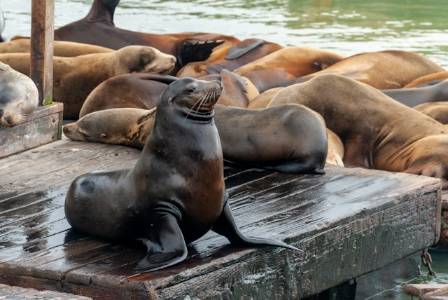
6. Male Sea Lions Are Much Larger
Male sea lions can grow considerably larger than females. Size also plays a role in mating, as females tend to seek out larger males as potential partners. In this particular case, being bigger can provide a reproductive advantage.
7. Sea Lions Are Highly Social Animals
Sea lions are playful and very social creatures that communicate with one another through a variety of sounds and behaviors. Scientists still do not fully understand the meaning of all the vocalizations they produce.
They commonly live and travel in large colonies that are divided into smaller social groups. Individual sea lions may move between these groups throughout their lives, somewhat resembling the changing social circles or cliques found among humans.
8. Older Sea Lions Can Develop Health Problems
As sea lions age, they become more vulnerable to certain health conditions. Older individuals may develop problems including pneumonia, epilepsy, and cancer.
9. Sea Lions Are Excellent Freedivers
Like humans, sea lions need oxygen to survive, but they are remarkably well adapted to spending long periods underwater. Their nostrils remain closed while they are submerged and open when they need to breathe, helping them move efficiently through the water.
Depending on the species, some sea lions can dive to depths of approximately 300 meters, or 984 feet. They can also remain underwater without breathing for as long as 20 minutes.
10. Sea Lions Can Adapt Their Hunting Techniques
Sea lions are capable of developing specialized hunting methods based on their environment and the prey available to them, much like orcas do in different regions.
Galapagos sea lions, for example, are known to hunt cooperatively. Groups may work together to herd or corral fish into shallow water, where the prey becomes easier to catch. They appear to use this strategy particularly when hunting tuna. Because tuna are relatively large and powerful, they would normally be challenging prey for sea lions to capture.
11. Sea Lions Can Live for Around 30 Years
The exact lifespan varies between species, but sea lions can live for a considerable amount of time. Their average lifespan is generally between 20 and 30 years.
12. Sea Lions Can Remain on Land for Extended Periods
Sea lions can hold their breath for up to 20 minutes, but they can also remain on land for surprisingly long stretches of time. In theory, a sea lion could stay on land indefinitely if it did not need to return to the ocean to find food.
In reality, extended periods on land are usually connected to important activities such as breeding, caring for young, or molting. During the breeding season, dominant males may remain out of the water for as long as 27 days while defending their territory. Females can stay on land for approximately 10 days after giving birth.
Sea lions can also remain in the ocean without coming ashore for surprisingly long periods. They may stay in the water for as long as two weeks without hauling themselves onto land to rest or dry off.
13. Sea Lions Can Swim Faster Than Humans
Sea lions are built for speed and can quickly escape when threatened by larger predators. Most species are capable of swimming at speeds of up to 30 miles per hour, or approximately 48 kilometers per hour.
For comparison, the highest recorded speed of the fastest human, Usain Bolt, was about 27.5 miles per hour, or 44 kilometers per hour. This means a sea lion can potentially outpace even the fastest human in the water.
14. Sea Lions Have Faced the Threat of Extinction
Human activity has played a major role in the historical decline of sea lion populations. People hunted these animals for many years, bringing some populations dangerously close to extinction.
Today, international laws prohibit the hunting of sea lions in an effort to protect their populations and support their continued survival. Conservation and legal protections have become important tools for preventing these remarkable marine mammals from disappearing.
More from the kitchen

· en
Mango Sago
Rachel Hughes

· en
5 Affordable Sports Cars That Look Amazing in Red
Eleanor Grace

· en
Seaside Reef
Selene Whitaker

· en
Lollipops: A Sweet Journey Through History, Culture, and Celebration
Mason

· en
From Mexican Roots to American Pantry Staple: The Evolution of the Tortilla Chip
Shirley Ann Bennett

· en
Low-Carb Fruits: A Nutritious Guide to Enjoying Sweetness Without Excess Carbs
Charlotte