Kitchen note
Landscape Painting: Get Your Rocks Right
Understanding how geological formations shape the appearance of rock and learning to depict these features accurately can bring a new level of depth and realism to your landscape paintings.
River Ash
Cook
Bench note
The full story and useful tips are below.
Shelf
Plant kitchen
Understanding how geological formations shape the appearance of rock and learning to depict these features accurately can bring a new level of depth and realism to your landscape paintings.
This guide isn’t about teaching brush techniques; instead, it’s about learning to observe and understand rock as a subject in itself so your landscapes feel authentic. As an engineering geologist, I already have a solid grasp of how geology determines the structure of the natural world, even though I am relatively new to painting.
Geology is the foundation that organizes the landscape. It dictates the height and steepness of mountains, the thickness and orientation of rock layers, the pattern of fractures cutting through rock outcrops, and the formation of ridges and valleys. To make rock formations in your paintings believable, you must convey this underlying geological framework.
Two fundamental rock characteristics are especially important for painters to recognize:
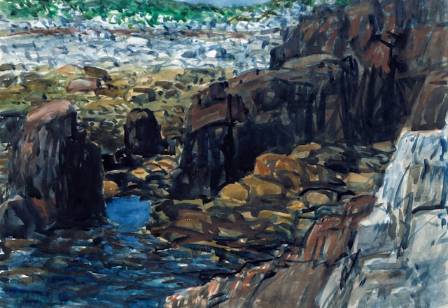
Rocks are fractured. These fractures create zones of weakness that define the lines and depressions between solid rock blocks. Fractures also determine the angles of cliffs and slopes. While the extent of fracturing varies, the orientation of these cracks tends to be consistent at both small and large scales across a landscape.
Rocks are layered. Most rocks occur in layers that maintain relatively uniform thickness, color, and texture along cliffs, outcrops, or hillsides. Layers differ in resistance to erosion, with harder layers forming ledges or ridges and softer layers forming slopes or depressions. Rock layers are often inclined or folded, with some folds exposed and others visible only as slanting layers.
Maintaining Consistency in Rock Painting
To make your rocks look natural, observe the spacing, thickness, and angles of layers and fractures, and apply them consistently throughout your painting. Keep the color, texture, and prominence of each layer uniform. Rock layers in the foreground may also appear in distant hills, and the angles of fractures often line up across the landscape.
Perspective for Rocks
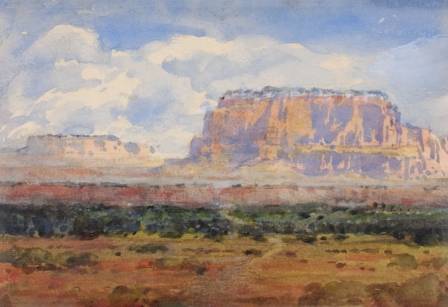
Rock formations follow the same principles of perspective as buildings. Horizontal rock layers converge toward the horizon. Layers at cliff tops appear steeper than similar layers at eye level. Edges of cliffs may curve downward slightly, even if the layers themselves are horizontal.
Inclined layers shift in elevation with distance. A layer dipping away from you will appear lower on a distant slope; one dipping toward you will appear higher. Layer orientation and perspective together create a realistic sense of depth.
Avoiding “Stone Wall” Appearance
Natural cliffs and outcrops are made of numerous blocks with both angular and rounded edges. Angular edges are shaped by fractures, while rounded edges result from weathering. Avoid painting rocks as uniform, rectangular blocks like a manmade wall. Instead, vary the block shapes, edge rounding, and rotation to mimic natural formations.
Cliff faces are rarely perfectly vertical or smooth. Differences in rock hardness create ledges and hollows. Fractures form blocks that extend outward. Observing and representing these variations makes your rock formations more convincing.
Adding Interest with Variation
Rocks change color and texture over time due to weathering. Dark rocks lighten and light rocks darken with exposure. Iron and manganese can stain rocks red, yellow, brown, or black. Weathering may produce horizontal or vertical bands and pitting where less-resistant minerals erode. Incorporating these subtle changes adds realism and visual interest.
Boulders Versus Outcrops
Boulders are individual blocks that have moved and rotated. They vary in shape, orientation, and texture. Adjacent boulders may differ in color and rock type.
Outcrops are connected rock masses attached to bedrock. They may look like boulder clusters but share the same layering, color, and fracture pattern across the entire formation. Both boulders and outcrops have angular and rounded edges, but the structure of outcrops is consistent with the surrounding landscape.
Five Tips for Painting Realistic Rocks
Identify the geological structure: maintain consistent orientation of layers, fractures, ridges, and ravines.
Apply perspective: rock layers converge toward the horizon and curve slightly downward at edges.
Cliff faces are not uniform: show subtle ridges, hollows, and irregular surfaces.
Include variation in color and texture: weathered rock lightens or darkens and often shows pitting or rounding.
Observe fractures: intact outcrops follow consistent fracture patterns, while loose boulders have random orientations.
More from the kitchen

· en
Still lifes in 17th century paintings
Amy Brown

· en
Modern mysteries of the universe
Lyra Wells

· en
How do robotic arms work
Chloe Reed

· en
Dolphins: The Carnivorous Maestros of the Oceans
Caius Thorne

· en
Why Does Swimming Make People Relax ?
Henry Everett

· en
Ancient Chinese Architecture and its Hidden Meanings
Julian Everly